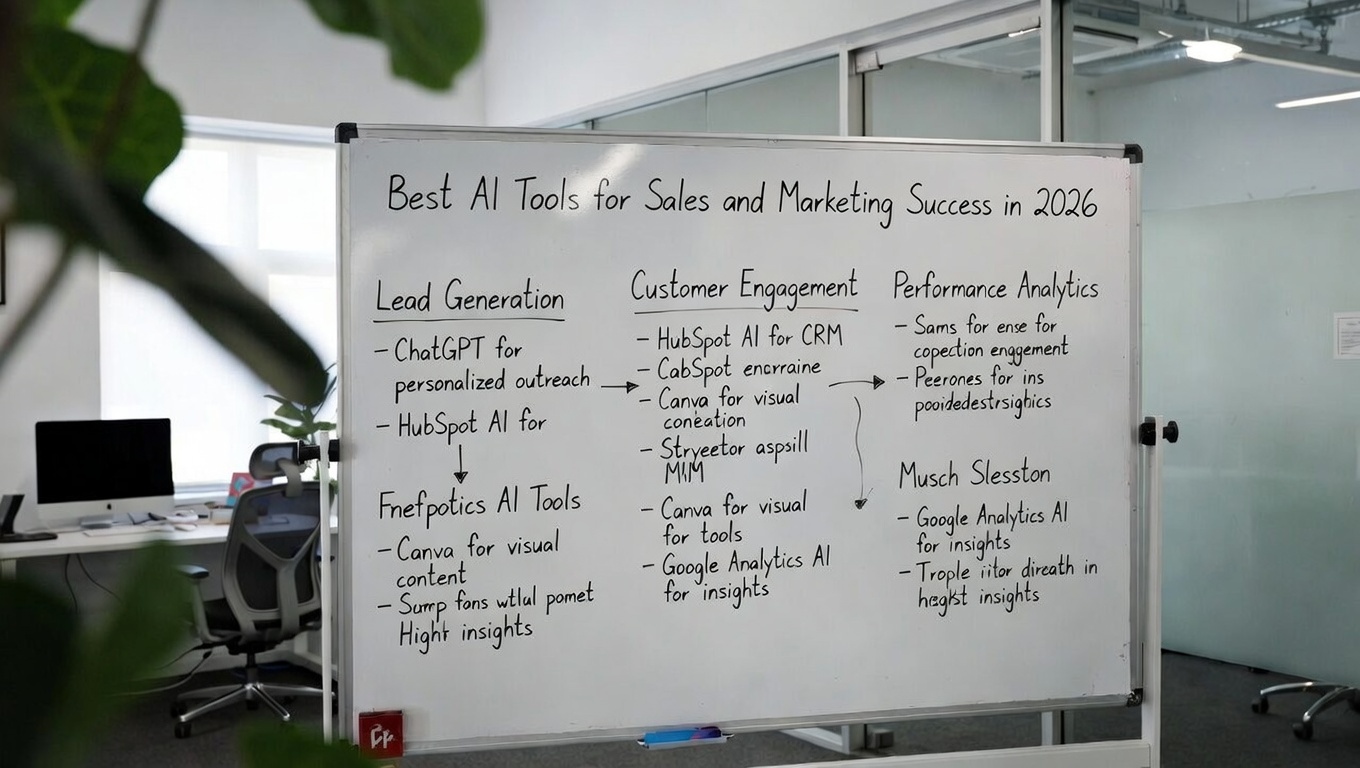
Best AI Tools for Sales and Marketing Success in 2026
Technologies are changing the world of sales and marketing as AI can assist businesses in reaching their customers in a much faster, smarter and efficient manner. Since AI has been used to generate leads, perform email marketing and social media management, it is now making it easier to grow the revenue and enhance the engagement.
ChatGPT, Claude, HubSpot AI, Salesforce Einstein and Jasper AI are some of the tools used to write content, analyse data and predict customer behavior. Companies will be able to save time, personalise communication and make data-driven decisions with the help of AI. This article examines the most successful AI tools in sales and marketing, their capabilities and the manner in which they assist companies to thrive in the contemporary competitive market.

Why is AI Essential for Sales and Marketing in 2026?
AI is the future of sales and marketing in 2026. It assists companies to know more about customers, trends and real-time optimisation of campaigns. The use of AI-based tools to sift through big data to determine buyer behavior, preferences and engagement patterns enables the use of personalised marketing tactics.
Automation saves the manual work, enhances efficiency and makes communication with leads and customers timely. Predictive analytics and performance tracking are other areas of AI that are used to improve decision-making.
Companies utilising AI get a competitive advantage by reaching the correct audience, enhancing the conversion rates and maximising the ROI. AI implementation in the sales and marketing process is a necessity rather than an option since the days of startups and businesses.
AI Tools for Lead Generation and Customer Acquisition
AI eases the process of lead generation and customer acquisition by automating research and targeting the appropriate prospects. Key benefits include:
Predictive Lead Scoring: It predicts good leads with the help of AI algorithms.
Chatbots and Virtual Assistants: Go ahead and respond to visitors in real-time, responding to questions and leads.
Behavioral Analysis: Monitors the activities of online users on applications or websites in order to optimise targeting.
CRM Integration: AI tools are integrated with platforms such as Salesforce or HubSpot. This helps to facilitate follow-ups.
Personalised Outreach: AI composes personalised messages to various segments of the audience.
The common AI applications in this context are HubSpot AI, Salesforce Einstein and Drift which assist in acquiring customers more quickly and effectively.
Top AI Tools for Content Creation and Copywriting
AI is transforming content creation and copywriting. It can create quality content, which is also engaging and fast. ChatGPT, Jasper AI, Copy.ai and Writesonic are some of the tools that assist a marketer to create blog posts, ad copy, social media content and product descriptions. AI examines the trends, the interest of the audience and the needs of search engines to produce content that will be optimised and more prominent in search engines.
Companies are able to conserve time, be consistent and produce content on a large scale when using AI. Also, it is possible to write, summarise and construct multilingual content with AI tools. Marketers will be able to concentrate on creativity and strategy with the use of AI in content strategies whereas AI will perform repetitious writing tasks. This will provide efficiency and more engagement in the audience.
AI in Email Marketing: Automation and Personalisation
AI can also be used to enhance email marketing, personalising the message and automating campaigns to increase the level of engagement. Artificial intelligence software examines the behavior of subscribers, their interests and previous contacts to access emails on the most appropriate time. Mailchimp, HubSpot AI and Salesforce Marketing Cloud are automation tools that enable the scheduling of campaigns, audience segmentation and performance monitoring.
AI is also used to come up with attractive subject-lines, email messages and A/B test variants to increase the open and click-through rates. Personalisation will make sure that every recipient will be sent relevant offers or content which will maximize their chance of converting. Companies can cut down on manual labor, achieve consistency and enhance ROI using AI. This helps in making email marketing more effective, more data-driven and more customer-focused.
Social Media Management with AI
Social media management with AI is simplified by automating content creation and scheduling, as well as analytics. Key benefits include:
Content Scheduling: AI systems such as Buffer, Hootsuite and Lately AI are used to post at the best time automatically.
Audience Insights: Examine the engagement behavior to learn about the follower behavior.
Trend Analysis: AI detects trending content to create relevant content.
Performance Tracking: Tracks likes, shares, comments and conversions in real time.
Social Listening: Identifies names, comments and sentiment so as to direct marketing strategy.
Artificial intelligence enables marketers to operate across multiple platforms effectively, produce interesting content and make data-based decisions. It is time saving, increases the reach, and enhances the general ROI of social media.
AI-Powered Chatbots for Customer Engagement
Chatbots with AI are changing the way customers are interacted with by giving them instant customer support and personalized interaction. These chatbots are able to provide answers, give suggestions and resolve complaints and steer the user through the sales funnel around the clock. Such tools as Drift, Intercom and HubSpot AI are integrated into websites, social media, and messaging applications to enhance the level of response and satisfaction.
AI chatbots are taught through dialogue and will become better with time and provide more human interaction. They automate the routine tasks and release human agents to tackle complex issues as well as maintaining customer engagement. AI chatbots assist companies to improve customer experience and build trust to increase conversions by using customized greetings, personalized recommendations and consistent customer support.
How AI Improves Customer Retention and Loyalty?
AI enhances customer retention and loyalty by learning their behavior and providing them with custom experiences. Key ways include:
Customised Recommendations: Recommendations are made on products or services based on the previous contacts.
Predictive analytics: Find customers who are at risk of churn and provide them with incentives in time.
Instant Interaction: Receive and send personalised emails, messages or notifications to stay in touch.
Sentiment Analysis: Know what customers say to make products and services better.
Loyalty Programs: AI develops loyalty programs that are specific to the individual preferences.
AI enables companies to develop better relationships, have subsequent buying and enhance loyalty addressing the needs in advance and offering experience-based interactions.
AI for Personalised Advertising and Targeting
AI helps to customise advertising and target it more accurately. It enhances performance and ROI of a campaign. Using customer data, browsing history and purchasing history, the AIs such as Google Ads AI, Facebook A and Adobe Sensei, will provide highly relevant advertisements to the appropriate audience. Predictive algorithms identify the most possible customers who will be involved or converted.
AI is also a useful tool in the creation of dynamic contents where visuals and messages are customised to user tastes. The real-time optimisation of retargeting campaigns is done to be as effective as possible. Marketers will be able to optimize on wasted adverts and increase engagement rates and provide hyper-personalized experiences using AI. This helps to ensure that each advertisement is relevant to the individual user.
Voice and Conversational AI in Marketing
Voice and chatbots are transforming marketing to a new direction where they can be used to have natural and interactive conversations with customers. Brands can now use voice assistants such as Alexa,
Google Assistant and Siri as well as chatbots through conversational AI. This requires speech, making them more accessible and convenient. Voice AI may be used in businesses to allow people to spend their time on searching products, booking appointments, customer support and personalised offers.
Conversational AI will process user contributions in real-time and provide valuable suggestions and answers. This brings out a more interesting and human-like experience that enhances brand perception.
Voice and conversational AI represent a transformative element of marketing because they can be combined by companies to ensure a better customer experience, engagement, and seamless hands-free interaction that enables conversion.
AI Analytics: Turning Data into Actionable Insights
AI analytics is the process of converting unstructured data into useful insights aiding marketers to make more intelligent decisions. Tableau AI, Google Analytics 360 and Salesforce Einstein Analytics can analyse customer behavior, web behavior and campaigns in real-time and analyze them. The identification of patterns, trends and correlations that a human would not realize is realized with AI. The use of data-driven approaches is possible.
Predictive analytics is used to predict customer behavior and sentiment analysis measures the response provided by social media and reviews. Based on these insights, marketers are able to optimise campaigns, change pricing and personalise content. AI analytics converts complex data into readable and usable intelligence which is more efficient and enhances ROI and ensures that businesses can adequately respond to market changes, customer needs, and competitive pressures.
AI for Competitor Analysis and Market Research
AI revolutionises the competitor analysis and market research by gathering, processing and analysing large volumes of data on websites, social media, reviews and news outlets in a very short time. Competitor strategy, product performance, pricing and marketing campaign intelligence is offered by such tools as Crimson Hexagon, Crayon and SEMrush AI.
AI determines fashions, unmet demands and prospects of the market, enabling businesses to find their position. Sentiment analysis appraises how people think, whereas predictive modeling predicts the actions of competitors. Automating research work saves time, enhances accuracy and promotes the use of data in decision-making by AI. Competitor analysis with the implementation of AI enables companies to become flexible and optimise strategies as well as obtain a competitive advantage in their sector.
Predictive Analytics: Forecasting Sales and Trends
The predictive analytics is an AI application that assists companies to make correct forecasts about sales, customer actions and market dynamics. Salesforce Einstein, HubSpot AI and Tableau AI are some of the tools that study historical data and identify trends to forecast the future.
Predictive models are useful in inventory planning, campaign optimization as well as growth opportunities. The marketers will be able to predict the customer needs, categorise high-value prospects, and make strategies to suit them. Live information will enable timely response to market dynamics.
Budget allocation and resource planning are also supported and enabled by predictive analytics which makes it efficient. Using AI to anticipate future events, companies decrease risks, make wise choices, and outperform their competitors, which will eventually boost revenue, profitability, and market share.
Using AI for Multi-Channel Marketing Campaigns
Multi-channel marketing campaigns are simplified through AI. This synchronizes the messages on different platforms (email, social media, websites, and mobile apps). Artificial intelligence tools such as HubSpot AI, Salesforce Marketing Cloud and Marketo are used to optimize the content delivery, timing, and personalisation of each channel. The AI processes real-time engagement data to optimise campaigns and ensure that it will get more open rates, clicks and conversions.
It also determines the most effective channels to use by each group of people and eliminates the unnecessary resources. Automation enables marketers to use the same brand and message and saves time doing the repetitive work. Through the inclusion of AI into multi-channel approaches, businesses can reach consumers in a more efficient way, better interaction and maximization of ROI in each of the marketing touchpoints.
FAQs
What AI technologies will provide the best sales and marketing tools?
The best AI tools are ChatGPT, Claude, HubSpot AI, Salesforce Einstein, Jasper AI and Drift. These are applicable in creating content, generating leads and analytics.
What is the way the AI enhances customer engagement?
Search engine chatbots, voice assistants and personalized campaigns deliver personalised, immediate and enhanced satisfaction and retention.
Are small businesses able to afford AI marketing tools?
Yes, there are countless AI solutions with affordable levels and free options. This is why they are available to small enterprises.
Is marketing automation with AI safe?
Yes, AI marketing is safe and effective when it is done with a platform that has data privacy, ethical considerations and integrations that are secure.
Conclusion
The sales and marketing of the future 2026 are changing with the help of AI that assists businesses in creating leads, customizing campaigns and interpreting information effectively. ChatBots such as ChatGPT, Claude, HubSpot AI, and Copilot enhance engagement, retention and ROI. The use of AI in strategies by companies of all sizes can help them become smarter, target the right audience and achieve sustainable performance in the competitive market.